That Sensitive Life

the art and science of human sensitivity

  • Home
  • About Us
  • Our Work
  • Writing Services
  • Paper Arts
  • Blog
  • With Thanks

March 29, 2016 By Sherman

Reading Behavorial Science, Another Caveat

Self testing…

Anyone who wants to quantify whether or not they are highly sensitive person, i.e. have sensory processing sensitivity, can go to Dr. Elaine Aron’s website www.hsperson.com and take the “Are You Highly Sensitive?” self test. Believe me, Cathy and I each easily exceeded the criterion of 14 true responses. In addition, for research purposes, the Arons have also developed a standard 27-item HSP scale, as well as a 6-item and 12-item scale, for evaluating sensory processing sensitivity. The individual questions are worded slightly differently although, in my opinion, the thrust of each questions is unchanged. Also, the responses are made on a scale of 1 to 7, rather than simply true or false, allowing further quantification of the responses. Despite these refinements, however, all of these tests are questionnaires and remain subject to all of the problems inherent in self-reporting instruments.

… equals self-reporting

Self-reporting is associated with a host of uncontrollable issues which affect one’s responses and skew results. These range from mood, “I’m having a bad hair day…” to outcome bias, or, “I know I’m highly sensitive, and I want to prove it.” Furthermore, self-reporting even comes with its own, scientifically recognized bias. This is Social Desirability Bias… the tendency of respondents to answer in a manner that will be seen in a favorable light by others.

Over the years, I have amazed myself with my own responses to personality inventory questions. No matter how truthfully I answer in the moment, certain aspects of my type or temperament seem to shift back and forth as the years pass. In fact, at some deeper level, I wonder to this day if I, or any of us, know ourselves well enough to tell the “truth” for each and every question we might be asked, or for that matter, the same “truth” each time a question is repeated. No matter how sincere we are or hard we try, truth may be a thing of the moment, colored by past experience and the passage of time, rather than a fixed entity.

“Know thyself,” the Greek aphorism, has always held a deep fascination for me… to the end that I question whether, even in the best of all possible scenarios, we can ever truly know ourselves. It seems to me that at any given moment I am the amalgam of a wide spectrum of mood, emotion, and behavior… at times surprising even myself… and here I am, so to speak, in front of this questionnaire trying to express who I am as though it were all I am.

Baumeister, Vohs, and Funder have published one of the best summaries in the scientific literature addressing issues of self-reporting as opposed to the observation and measurement of actual behavior (http://rap.ucr.edu/baumeisteretal2007.pdf). Written in an accessible style and without inflammatory rhetoric, the authors lay out the problem researchers face when studying social and psychological behavior.

This is not a perfect world, so…

In scientific research, at any point in time we are stuck with the tools we have. When they are applied fairly, when the results are appropriately evaluated, and when the results can be reproduced or replicated, our body of knowledge of the world, and our place in it, has most likely been enlarged or clarified. Were it not so, the advances in knowledge made in even one lifetime would not be possible. Therefore, in my opinion, it is not that scientific research has pitfalls that is problematic, it is that the media, and those of us who read and listen to it, accept too much at face value and proceed to parrot this received information without sufficient appreciation for the probability it will be modified, or even refuted, over time.

These two blogs, I hope, have provided a foundation for the skepticism necessary for reading science. Now, I hope, we can begin to enjoy some of the insight science has brought to light about the world of the highly sensitive person.

—Sherman Souther
Filed Under: science Tagged With: highly sensitive, highly sensitive person, human sensitivity, interpreting science research

March 13, 2016 By Sherman

LONGBOATS

On the other side of a beach formed from stones, washed of sand, a gray sea swallows the setting sun. Over pints of bitter, close to a salt-streaked window, men repeat to one another stories of boats and hounds. On occasion, they glance out through the gloam, to the darkening hill and a cemetery filled with others not born to their ancestors.  Across the road, far back from windows of uneven glass, reflecting the dusk, women quietly knit from knots of dull wool. They talk of the boy with thick, yellow curls who cries out in the night about sails formed from red diamonds. Such cloth these women have never seen, although one recalls a family myth about the day the howling dogs went silent.

—a prose poem by Sherman Souther

Filed Under: art Tagged With: human sensitivity, poetry

March 6, 2016 By Cathy

The Paper, Not the Pixel

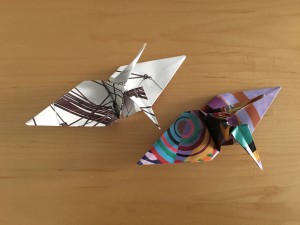
Origami Cranes #2999 (top) and #3000.

I’ve reached 3,000 origami cranes.

Some people watch TV. Some surf the internet, or the ocean. Some play video games, or even FreeRice. I fold origami cranes, and give them away.

Four years ago this weekend, I took my first origami class in a tiny paper store in Albuquerque. And today, I just finished folding origami crane number 3000.

I tried to learn to fold origami cranes from Youtube, but only when I went to that live, hands-on class did this 26-fold process really fill in for me.

The nurse Mrs. Martello, in Eudora Welty’s “The Optomist’s Daughter” crochets baby bootees. Direct from the book: “You’d be surprised how fast I give out of ‘em…” she said. “It’s the most popular present there is.”

I could say the same for giving away origami cranes.

A woman sitting on the seat on her walker enjoying the sunshine on the street in front of her building receives a crane from me with her two hands, looks up and smiles.

Like crocheting, folding paper calms the central nervous system. And everyone wants a crane or two. Even strangers on the street.

Sherm bought me a subscription to the magazine Art News last year. It’s my first magazine subscription that’s not digital. There’s something about seeing the art in print (that you’ll never see in person anyway) as opposed to in pixels.

Those pages are so colorful and amazing that I couldn’t throw the magazines into the recycling bag. I began folding them for my origami project. One crane had Gandhi on it, from a photograph. Another, a Robert Motherwell reproduction. One or two with art by Yoko Ono. And so on.

Recycle, or upcycle? Both? Hey, those beautiful pages make lovely origami. Most magazines are printed on glossy paper too tenuous to fold. Lately, another favorite of mine to fold is Edible Magazine. Lovely paper for folding, with great colors.

Filed Under: art Tagged With: origami, origami cranes, paper cranes, sensitivity

February 16, 2016 By Cathy

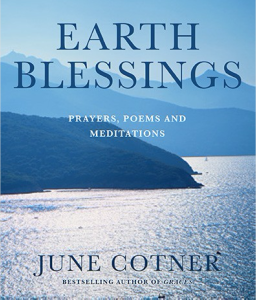
An Abundance of Earth Blessings

Earth Blessings   I recently learned that a poem of mine will be published in the lovely, timely anthology by June Cotner entitled Earth Blessings: Prayers, Poems and Meditations. I wrote this particular poem, called September’s Early Dusk, when I lived in Colorado. One day I drove from the edge of the foothills of the Rockies out onto the eastern plains, and when I returned, this eight-line poem seemed to tumble from my pen-in-hand into a journal I kept in the car just for that purpose. I was already writing a series of ghazals, a form of poetry from ancient Persia, and September’s Early Dusk fit with that style. This poem of mine also was published in my first poetry collection by Blue Light Press, Solstice Windows.

Earth Blessings is scheduled for release in paper and ebook on March 8, 2016. Visit this link for more information.

—Cathy Capozzoli

Filed Under: art Tagged With: Earth Blessings, poetry

October 21, 2015 By Sherman

Scientific Research: Reader Beware

I remain awed by of the scope of science, and I have a favorite illustration. Take a look at the chart, “The scale of the universe mapped to the branches of science and the hierarchy of science.” (http://en.wikipedia.org/wiki/Science#cite_note-1) The flow of logic and mathematics into physics and chemistry and on to cellular and functional biology before ending in psychology and sociology fascinates me…all of this continually augmented by the ever growing mass of information about the natural world and the human condition… and all produced by research. Most often, the results of this research are presented at scientific meetings and published in scientific journals. Both of these activities are presumably peer-reviewed, and the information is eventually translated into the media experience which now envelops us.

Most of this work is well done. We would not have progress, as we know it, without it. But simply because scientific papers are reviewed, published, and popularized does not necessarily make their research reproducible. It does not necessarily make them well evaluated. It does not necessarily, in fact, make them without bias, accurate, or even honest. All of this work is done by people. As people, we have limits. For example, until we develop new tools for exploration, we are limited by the ones we have. As people, we are susceptible to error of all types. The list is long. Also, as people, we also have individual needs, and some of us have less integrity than others. Hence the need for skepticism and doubt. Let’s dig a bit deeper…

Results and Reproducibility

Many authors use “reproducible” and “replicable” synonymously. Not all, however, and here is both some of the delight and some of the frustration I have with language. Chris Drummond is an expert in machine learning at the National Research Council of Canada. He argues that replicating studies does not advance knowledge in the same way reproducing them does, nor are they good science. (http://www.site.uottawa.ca/ICML09WS/papers/w2.pdf)

Drummond’s thoughts on what is good science and what is knowledge are provocative and instructive. And even if his distinctions prove little more than semantic rhetoric, our observations, ideas, and results need substantiation in some form if we are to act with confidence.

All too often, the results of published research cannot be achieved by duplicating the original experiments, leaving us in doubt about the validity of the initial work. In 2005 John Ioannidis, Professor of Medicine at Stanford, published one of the most cited articles in current scientific literature. The title… “Why Most Published Research Finding Are False.” (http://www.ncbi.nlm.nih.gov/pmc/articles/PMC1182327/) In 2012, “Psychological Science,” the journal for the Association for Psychological Science, devoted an entire section of the November issue to a crises of confidence (http://pps.sagepub.com/content/7/6/528.full.pdf+html) on replicability in psychological research. And if you think things have recently improved, a massive, collaborative study attempting to reproduce results published in three different, respected psychology journals resulted in only 35 of 97 successful replications. (http://etiennelebel.com/documents/osc(2015,science).pdf) I can’t resist quoting from the end of the summary portion of the article: “…there is still more work to do to verify whether we know what we think we know.”

Research and Peer Review

Peer review has proven a poor filter. A 2013 article in The Economist titled “Trouble at the Lab” (http://www.economist.com/news/briefing/21588057-scientists-think-science-self-correcting-alarming-degree-it-not-trouble) chronicles the many problems with peer review. These range from the embarrassing consequences of clever stings by a Harvard biologist and another by an editor of the British Medical Journal on through failure by reviewers to conduce their own analysis of the data presented or adequately assess the experimental purpose or design. Moreover, the performance of reviewers declines with experience (http://www.annemergmed.com/article/S0196-0644(10)01266-7/abstract). Would that reviewers aged as well as wine.

Research Fraud

There also are multiple references regarding egregious fraud as well as other dodgy practices in the articles cited. To me, this is the saddest. I do, however, understand the motivation. When I most frequented the research laboratory in the decade between 1965 and 1975, I viewed the authorship or co-authorship of published papers as “academic gold.” Those investigators with an extensive bibliography got jobs, grant money, promotions, and awards. Unsurprisingly, this has not changed. (http://pps.sagepub.com/content/7/6/528.full.pdf+html)

Intense competition dominates academia. Without integrity, the lure of easy and rapid advancement of one’s career is powerful.

So, How Should We Look at Scientific Research?

Most of us, including me, do not gain information or insight by reading scientific papers. We read or hear the sanitized and popularized received information available from the media, often in multiple formats. This translation further enhances the possibility of error, lack of due diligence, or dishonesty. Maintaining some degree of skepticism or doubt concerning what we are told is important. The philosopher, George Santayama, has given us another, more organic, view of this quality. “Skepticism is the chastity of the intellect, and it is shameful to surrender it too soon or to the first comer: there is nobility in preserving it coolly and proudly through long youth, until at last, in the ripeness of instinct and discretion, it can be safely exchanged for fidelity and happiness.” (www.philosophicalsociety.com/archives/skepticism.htm)

We all benefit from the insights new revelations give us, yet we need to maintain some reserve regarding them until they are confirmed.

—Sherman Souther

Filed Under: science Tagged With: human sensitivity, scientific research, writing

  • 1
  • 2
  • 3
  • Next Page »
  • Connect
  • Home
  • About Us
  • Our Work
  • Writing Services
  • Paper Arts
  • Blog
  • With Thanks
Logo: “Tranquility” hand-carved in soapstone from a Chinese seal collection curated by Oriental Art Supply.
© Cathy Capozzoli · Website by SixteenJuly.